
TENS stands for Transcutaneous Electrical Nerve Stimulation. TENS units send electrical pulses through the skin to the nerves to control pain. Unlike drugs, TENS does not have any major side effects.
The TENS blocks pain signals and confuses your brain so that you are not aware of the pain. Your body releases natural pain killers called endorphins. These chemicals block the awareness of pain. This is how the TENS may provide pain relief, even after it is removed. You may wear a TENS unit as needed to help with pain.
How to Start a Session
Make sure the device is turned off and then connect the lead wire(s) to the patches and the device.
Wash and dry the skin areas where you will be putting the patches.
Apply the patches to your skin surrounding the incision or painful area.
On the device, press the on/off button.
Use the Ch1 and Ch 2 buttons to set the strength for each channel. Increase the strength until you feel a strong but not painful feeling. It should not cause your muscles to contract.
It should never hurt. If it starts to hurt or feel uncomfortable, turn the intensity down.
Electrode Patches
The electrode patches can be reused 10 to 15 times, depending on skin type and electrode care.
Do not pull on the electrode wire. Doing so may damage the wire and electrode.
Position the electrodes with a minimum of 2 inches apart between them. Do not let them touch each other.
Do not reposition the electrodes while the device is turned on.
If there is no pulse felt in one electrode patch, it is not in a good position. Turn off the unit, reposition the patch and try again.
Electrodes should be removed from skin and placed on plastic backing between use to allow skin to dry and decrease risk of rash or other complications.
The most common problems with TENS therapy are caused by failure to wear the electrodes as directed.
Electrode Patch Placement
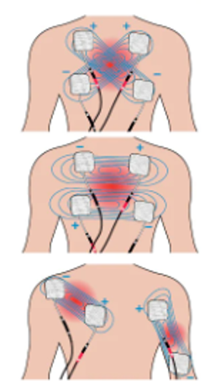
Some common Electrode placement methods when using multiple channels include:
Cross-Aligned (“X pattern”): current from each channel crosses where most of the pain comes from
Parallel: Each channel is parallel to one another, allowing for a broader area of pain to be covered
Multiple Areas/Body Parts: Each channel targets a different area or body part, allowing multiple pain areas to be treated
There is no “wrong” place to put the patches, except on the areas listed below. You can place the patches over pressure points, muscles, or the area where you have pain. The best spot depends on where you feel pain and how the treatment feels.
Do not place patches:
On your head
Over your throat or eyes
In your mouth
On broken skin
On a joint, such as your knee, elbow, or ankle
On areas that are numb or have less feeling
On areas with varicose veins
On areas recently treated with radiation
How to Change a Session
You can change options by pressing any of the ten program buttons. The therapeutic body part program can be selected by pressing the [S] button. The body part program icon will flash after selected.
There are four choices available for treatment time: 15 minutes, 30 minutes, 60 minutes and continuous. The treatment time can be selected by pressing the [T] button.
The Safety Lock turns on after you stop changing the intensity for 30 seconds. This helps prevent accidental changes to the settings or intensity. To unlock the buttons, press either down button.
How to End a Session
On the device, press the on/off button and hold to shut the device off for approximately 3 seconds.
Disconnect the wire(s) from the patches.
Remove the patches from your skin. Place back on the plastic backings between uses. If they are too dry, apply a drop of water to the patch.
Use skin cream or lotion to your skin after taking off the patches.
When You Should Not Use
Do not use the patches:
If you have a pacemaker or implanted defibrillator
If you are pregnant
If you have a heart monitor, history of seizures, or cancer, unless your doctor says it is safe
If you have a blood clot, bleeding disorder, or active bleeding
Around water