Notice
Welcome Beaver Dam patients! For information about the transition to UW Health, please review our frequently asked questions page.Read more
Welcome Beaver Dam patients! For information about the transition to UW Health, please review our frequently asked questions page.Read more

An overnight sleep study is a test done in the hospital to see how much or how well your child sleeps. The study checks your child’s breathing, heart rate, oxygen levels and body movements during sleep. It helps your doctor decide what, if any, equipment your child needs to get a better night’s sleep.
Comfort items such as pillows, blankets or toys.
A two-piece pajama set (without feet) and a pair of socks.
If your child uses a pacifier, bring different sizes in case one works better with the equipment.
Bring any medicine, equipment and supplies your child may need. We provide meals for your child during the study.
If your child is on a ventilator, bring both ventilators, circuits, and connections to humidity.
If your child uses CPAP or BIPAP, bring all masks, tubing, and the CPAP or BIPAP machine. We use your child’s home equipment during the test.
If there are things that help calm and distract your child like a DVD, iPad or other toys, bring these with. It may take 30-60 minutes to get all the equipment on your child for the sleep study.
Avoid tight braids, hair pieces, hair weaves or hair oils. They can make it hard to put electrodes on the scalp.
We will admit your child to the hospital the afternoon of the sleep study. Come to the American Family Children’s Hospital at 4:00 pm. If your child’s sleep study is coordinated with a video EEG, your child may be admitted earlier in the day to allow for EEG lead placement. There is valet parking at the front entrance. Then, find the Guest Depot on the first floor. If your child is already in the hospital, the sleep study is done in their room.
One parent/caregiver needs to stay with the child overnight to help with the sleep study. Please tell your care team if no parent/caregiver is able to be present throughout the hospital stay. We will discuss whether we can move forward with the study. Other children cannot stay overnight. Please have all other family sleep at home or with relatives/friends during the test.
You may be asked to wake up a few times during the night to help. You may be tired the day after the study. Plan ahead if you have a long drive home the next day.
If needed, The Ronald McDonald House provides housing for families whose kids are in the hospital. Call the Guest Depot at 608-890-8000 to arrange for your first stay at the house. If you have stayed there before, you can call the Ronald McDonald House directly at 608-232-4660. There is no cost to stay at the Ronald McDonald House, but if you are able, they ask for a $10.00 donation per night.
The doctors and nurses on the unit will ask you about your child’s health history and do a physical exam. The pharmacist will talk to you about the medicines your child takes. A respiratory therapist will check your home equipment.
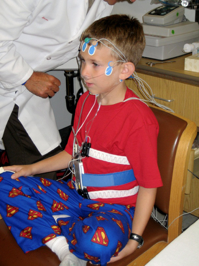
A sleep technician will hook up your child to the monitors and sensors that are part of the sleep study. These sensors tell us about the stages of sleep and whether sleep is being disturbed. None of these are painful. There are no needles. The sensors include:
Electroencephalogram (EEG) to measure brain waves.
Electromyogram (EMG) monitors.
Sensors placed at the nose and mouth measure the flow of air in and out of the lungs.
Belts around the chest sense your child’s breathing effort.
Electrocardiogram (EKG) measures heart rate.
A sensor attached to a finger or toe (pulse oximeter) measures oxygen levels.
There will most likely be another EMG monitor attached to your child’s legs to measure movements.
A microphone is placed to detect snoring.
A video camera allows the sleep tech to watch your child during sleep. The camera will record any unusual behaviors during sleep.
You can help distract your child while these sensors are being placed. If your child does not like the sensors being put on, the tech will try to attach them after your child has fallen asleep.
The sleep tech will be outside your door checking your child during the night. There may be times they need to wake you for help. The nurse may also need to come in and help.
The respiratory therapist may need to connect your child to new equipment or change settings for better sleep.
The sleep study ends around 5-6 am. The nurse, the pharmacist and doctor will need to see your child before you go home. We plan to discharge late morning or early afternoon once the inpatient team has seen you for rounds.
A sleep doctor looks at the results of the sleep study the next day. You will receive the results within a week from the pulmonologist and/or neurologist. This is within a week after the study. Contact the doctor who ordered the test if you have questions about the results. If you have other health questions, contact your child’s primary care doctor.
Call if you have any questions about the sleep study.
If you can’t make your visit, please let us know at least 5 days before the study. We don’t have a lot of open times for sleep studies so keep your visit if you can. The sooner you let us know, the more likely we are to be able to give the time to someone else. Reasons to cancel or reschedule a sleep study include:
Fever greater than 100.5°F
Major cough
Nasal congestion
Major illness
If your child gets sick, contact the Pediatric Pulmonary nurse as soon as you can.
Pediatric Pulmonary Clinic
Monday-Friday, 8 am- 4:30 pm
608-263-6420 or 800-824-8924, Option 2
After hours, nights, weekends and holidays, please call the paging operator at
608-263-6420 and ask for the pediatric pulmonologist on call.