Notice
Welcome Beaver Dam patients! For information about the transition to UW Health, please review our frequently asked questions page.Read more
Welcome Beaver Dam patients! For information about the transition to UW Health, please review our frequently asked questions page.Read more

Spasticity is when the muscles resist movement and become stiff. The faster the muscle is moved, the greater the stiffness. People with spinal cord injury may have severe spasticity.
Dystonia is when muscles tighten on their own.
When combined, spasticity and dystonia result in twisting and odd postures. In children, this is often described as going between being limp as a noodle and tight as a board.
Spasticity and dystonia may be seen in people with cerebral palsy. It can also be seen in those with a brain injury. It often causes problems with ease of movement, comfort, and care giving.
Baclofen is a medicine that eases muscle movement. It can be given by mouth.
If the oral form isn’t helping enough, it can be given into the cerebral spinal fluid (CSF). “Intrathecal” refers to giving medicine directly into the CSF.

A patient will need the pump if they receive the medicine through the spinal fluid. The patient will have the pump implanted inside the body. The pump allows a constant amount of baclofen.
A baclofen pump may help if:
Your child has spasticity or dystonia that affects the arms and legs.
Your child has problems with daily care, pain, or sleep.
Your child’s body is big enough to hold the pump.
Your child has enough strength in the neck and trunk.
A health care team will assess each child. This takes place in the Spasticity and Movements Disorders clinic at AFCH.
Parents can ask their child’s primary doctor for a referral to the center. Parents may call (608) 263-6420, option 3 to schedule a visit.
Your child will need a physical exam, health review, and lab tests.
Your child should stop aspirin and ibuprofen for two weeks before surgery. Use acetaminophen (Tylenol®) if needed.
Wash your child with Sage clothes as instructed.
We will call you the day before surgery to tell you when your child should stop eating and drinking.
Your child should not wear make-up, jewelry, or nail polish.
The system includes a pump, a tube (catheter) that goes into the spinal column, and a computer. The disc shaped pump is about 3 inches wide and 1 inch thick. It uses a lithium battery that last 7 years.
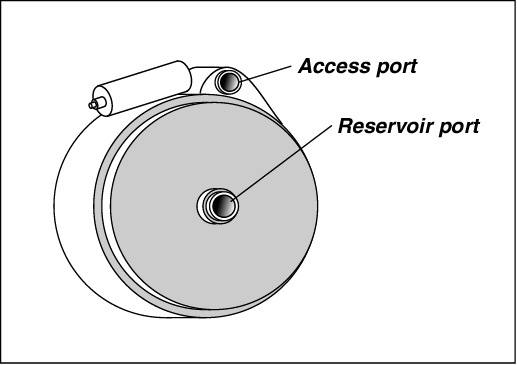
Through a small incision in the back, we thread the baclofen pump tube into the spinal column. We guide the other end of the tube to the abdomen and attached it to the pump. We place the pump through an incision in the mid to lower abdomen.
We set the pump to give a fixed amount of baclofen over 24 hours. Surgery takes about 2 hours. We can adjust the pump as needed.
Your child will have mild pain involved. Your child can take medicine to help relieve pain.
Your child will need to stay 3-5 days in the hospital. Your child can go home when they can eat and drink normally.
Your child will have a bandage over the incisions. You will need to keep this dry and clean.
Your child will have a clinic visit in 7-10 days. The bandage and staples will be removed at this time.
Wait at least two weeks before taking your child to get any vaccines.
Check the incisions twice a day until they are healed.
While the pump is in place, your child should avoid:
Extreme heat and cold (hot tubs, saunas over 102 degrees F) and pressure changes.
Scuba diving under 2 atmospheres.
Aircraft that isn’t pressurized.
Bungee jumping.
Sky diving.
You should always have an up-to-date and filled prescription of oral baclofen on hand. If the pump does not work or the small tube becomes clogged or disconnected, your child may have symptoms of withdrawal. Give the oral baclofen.
Call your child’s health care provider and schedule a visit the same day.
Severely increased spasticity or dystonia
Severe sweating
Severe itching without a rash
Fever
Seizures
Fast heart rate
Rapid breathing
Agitation
Irritability
Call right away if you see symptoms of baclofen overdose. If your child has too much baclofen, your child may be:
Listless
Floppy
Very sleepy
Lightheaded or dizzy
Breathing slowly
Patients with baclofen pumps will need regular clinic follow-up visits for dose changes and for pump refills. You must keep these appointments.
For signs of baclofen withdrawal or overdose.
Redness, pain, or swelling of the skin at or near the site.
Drainage from the incision.
Fever over 101.5ºF in the first three months.
Headaches that keep coming back.
American Family Children’s Hospital Clinics
(608) 263-6420, option 3
After hours, weekends and holidays, please call the paging operator at (608) 262-0486. Ask for the neurosurgeon on call. Leave your name and phone number with the area code. The doctor will call you back.
Toll-free number: 1-800-323-8942.